
What’s Happening in Bollywood Music in 2026?
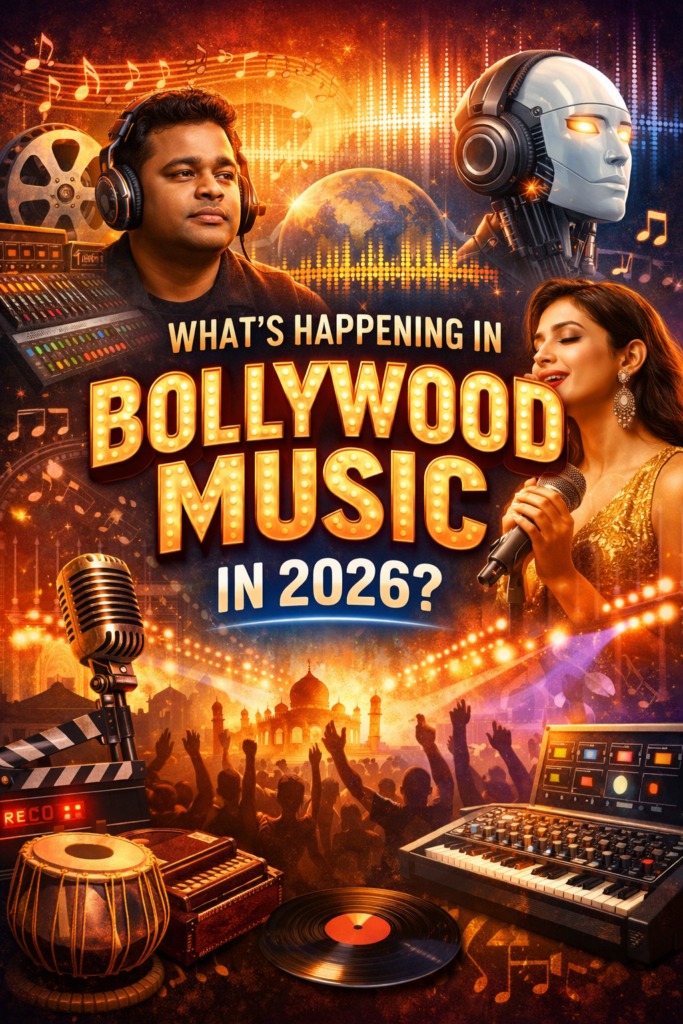
Bollywood music in 2026 stands at a defining intersection of creativity, commerce, and cultural conversation. While Hindi film songs continue to dominate Indian playlists and social media trends, the ecosystem behind them is undergoing visible change. From evolving playback practices to debates around artistic control and technology, Bollywood’s music industry is clearly in transition.
A Shift in Creative Power
One of the most discussed developments in recent months has been the growing concern among veteran composers and singers about creative authority. Renowned music directors have openly spoken about how decision-making in Bollywood music is increasingly influenced by non-creative stakeholders such as producers, marketing teams, and algorithm-driven trends.
This shift has led to a noticeable change in how songs are conceived. Music is often designed to be instantly viral — optimized for reels, short videos, and hook-based consumption — sometimes at the cost of lyrical depth and melodic longevity. While this approach boosts short-term visibility, it has also sparked debate about whether Bollywood music is moving away from its storytelling roots.
The End of Fixed Playback Voices
Another major trend shaping 2026 is the decline of fixed playback singers associated with specific actors. The traditional model — where one voice became synonymous with a particular star — is steadily fading.
Today, filmmakers are prioritizing vocal texture and mood over familiarity. Multiple singers may be considered for the same actor depending on the emotional requirement of a song. This has opened doors for newer voices and increased stylistic diversity, while also challenging established singers to stay adaptable and relevant.
Technology and AI in Music Production
Technology continues to redefine Bollywood’s music workflows. Advanced production tools, virtual instruments, and AI-assisted processes are increasingly common in composition, arrangement, and background scoring.
While AI is not replacing composers or singers, it is influencing speed, efficiency, and sound design. At the same time, concerns around originality, over-processing, and creative dependency remain part of the larger conversation. In 2026, the industry is still negotiating where to draw the line between assistance and authorship.
Streaming, Reels, and Chart Dynamics
Streaming platforms and short-form video apps now play a central role in determining a song’s success. A track’s performance is often measured less by album cohesion and more by how well a 15-second section performs online.
As a result:
Songs are getting shorter
Hooks arrive earlier
Production favors punchy intros and loop-friendly sections
Despite this, romantic ballads and emotionally driven tracks continue to perform strongly, proving that listeners still value connection and melody when delivered authentically.
Revival of Classics and Musical Nostalgia
Interestingly, alongside modern experimentation, 2026 has also seen a revival of older Bollywood songs. Classics from previous decades are trending again through remixes, reels, and rediscovery by younger audiences.
This nostalgia wave highlights Bollywood music’s timeless appeal and reinforces the idea that strong compositions can outlive generations — regardless of format or platform.
Live Music and Musical Homage
Live concerts, tribute shows, and musical homages have gained renewed importance. Events celebrating legendary composers, classical influences, and playback icons are drawing large audiences, reaffirming respect for musical lineage.
These performances also emphasize the continued relevance of classical training and live musicianship, even in an era dominated by digital production.
Global Reach and Cross-Cultural Influence
Bollywood music in 2026 is more global than ever. Collaborations with international artists, cross-language projects, and global distribution platforms are expanding Hindi film music’s footprint beyond India.
At the same time, Bollywood is absorbing influences from Afrobeat, electronic pop, Middle Eastern scales, and regional Indian music — resulting in hybrid soundscapes that reflect both global trends and local identity.
I signed up to bet7klogin a while ago and have had fun since. The site navigation is pretty smooth too. You should give bet7klogin a look. You can use my invite code, ha!
Yo, KA9Game is legit! I’ve been playing here for a while, and the games are actually fun. Plus, payouts are smooth. Check it out! ka9game
Baterybetinlogin? Sounds interesting! I signed up and it’s pretty straightforward. Easy to navigate and they have a decent selection. I’d say give it a shot. baterybetinlogin
I’ve tried a few platforms recently but this one is surprisingly smooth. The login process is quick and I didn’t encounter any lags. Definitely a solid choice for local players. Check out jilionelogin for a great experience.