
Circle of Fifths in Songwriting
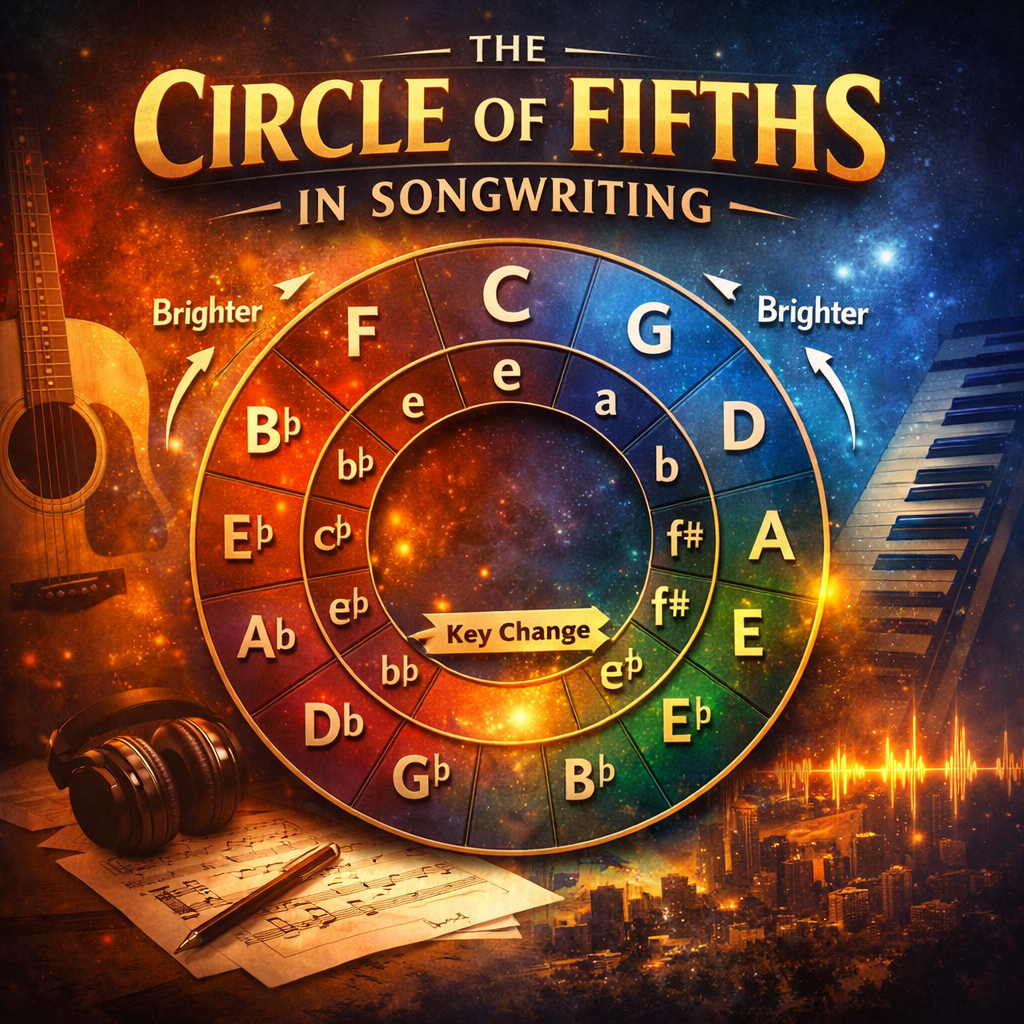
The Circle of Fifths is one of the most powerful tools in music theory, yet for songwriters and producers, it’s not just theory — it’s a practical roadmap for emotional movement, chord flow, and key control.
If chord progressions feel random, the Circle of Fifths is what turns them into intentional musical storytelling.
The Circle of Fifths is a diagram showing relationships between all 12 musical keys. Each step clockwise moves up by a perfect fifth interval.
Clockwise movement:
C → G → D → A → E → B → F# → C#
Counter-clockwise movement:
C → F → Bb → Eb → Ab → Db → Gb
These movements define how chords naturally want to resolve.
Why It Matters in Songwriting
Music feels satisfying when chords move in ways our ears recognize as stable or resolving. The strongest movement in harmony is:
Root motion by a fifth
Examples:
G resolves strongly to C
D resolves strongly to G
A resolves strongly to D
This is why so many songs rely on V → I resolution.
The Circle Creates Emotional Direction
| Direction | Emotional Effect |
|---|---|
| Clockwise | Brighter, energetic, uplifting |
| Counter-clockwise | Warmer, softer, emotional |
| Jump across circle | Dramatic key change |
Songwriters use this to shape the emotional arc of a song.
The Famous Progressions It Explains
1. ii – V – I (The Most Important Progression in Music)
Example in C Major:
Dm → G → C
Each chord root moves counter-clockwise on the circle. This creates smooth tension and release.
Used in:
Jazz
Gospel
R&B
Pop ballads
2. Circle Progressions (Descending Fifths)
C → F → Bb → Eb → Ab → Db
This continuous motion creates a flowing, cinematic sound. Film composers use this to build emotional intensity.
3. Pop Songwriting Formula
I → V → vi → IV
C → G → Am → F
Notice how C → G follows the circle. That strong motion gives the progression power.
Using the Circle for Song Sections
| Song Part | Circle Strategy |
|---|---|
| Verse | Stay close on circle (smooth flow) |
| Pre-Chorus | Move further away (tension) |
| Chorus | Return toward tonic (release) |
| Bridge | Jump across circle (surprise) |
This creates a natural emotional journey.
Modulation (Changing Keys)
The Circle shows which key changes will sound smooth.
Easy modulations: Move to a neighboring key
C → G
C → F
Dramatic modulations: Jump across circle
C → F#
Film and worship music use this to create lift moments.
Chord Function and the Circle
| Function | Position in Circle |
|---|---|
| Tonic | Home position |
| Subdominant | One step counter-clockwise |
| Dominant | One step clockwise |
Example in C:
F (Subdominant) → G (Dominant) → C (Tonic)
This movement powers countless songs.
Producer Perspective
The Circle helps you:
Build progressions that feel natural
Avoid random chord choices
Control tension and release
Create cinematic build-ups
Transition between sections smoothly
When producers say a progression “flows,” it usually means the chords are following circle logic.
The Core Rule
Chords that sit next to each other on the Circle of Fifths almost always sound good together.
That’s why:
G works with C
D works with G
F works with C
Final Takeaway
The Circle of Fifths is not just a diagram — it’s the engine of harmonic motion.
It explains:
Why certain chords resolve
Why some key changes feel smooth
Why classic progressions never get old
Master this tool, and you gain control over the emotional direction of your songs — instead of guessing, you design the feeling.
Love the variety of games here. I had a great run last night and the customer support was very helpful with my deposit. Check out phjilibit
Finally a platform that actually works smoothly in my region. The login process is seamless and the app performance is top notch. bajiloginpakistanapp is definitely the way to go.
If you are looking for a stable and fair gaming platform this is it. The customer service is top tier and always responds quickly. Visit vnvipee88 today.
[5503]Idamantoto: Login Daftar Akun & Slot Gacor Deposit Dana,Idamantoto menyediakan akses login dan daftar akun mudah. Nikmati slot gacor deposit dana serta download APK casino terpercaya. Gabung dan main sekarang. visit: idamantoto