
Indian Classical Music: The Foundation of Raag and Thaat
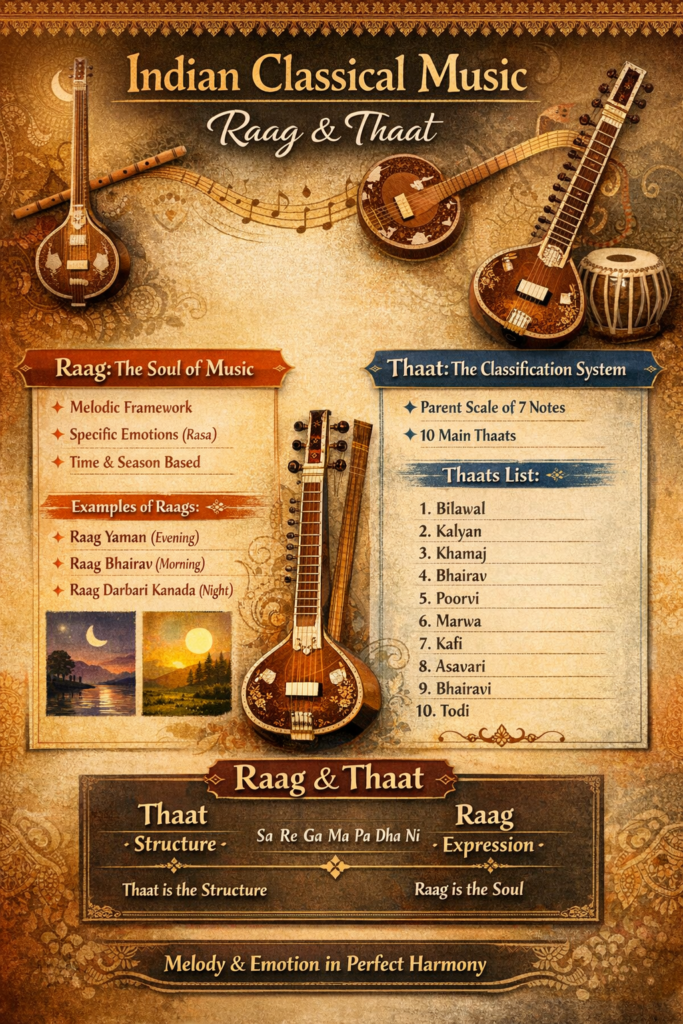
Indian classical music is one of the world’s oldest and most sophisticated musical traditions, with roots that stretch back thousands of years. Deeply connected to Indian philosophy, spirituality, and aesthetics, it is not merely a form of entertainment but a structured system of sound designed to evoke specific emotions, moods, and states of consciousness. At the heart of this tradition lie two fundamental concepts: Raag and Thaat. Together, they form the theoretical and practical backbone of Indian classical music.
Understanding Indian Classical Music
Indian classical music is broadly divided into two major traditions:
Hindustani Classical Music (North India)
Carnatic Classical Music (South India)
While both systems share ancient origins and core principles, they differ in style, structure, and presentation. The concepts of Raag and Thaat are primarily associated with the Hindustani system, although Carnatic music follows a parallel framework known as Melakarta.
Raag: The Soul of Indian Classical Music
A Raag (also spelled Raga) is not simply a scale. It is a melodic framework that defines how notes are used, emphasized, and ornamented. Each raag is designed to create a specific emotional atmosphere, known as Rasa.
Key Elements of a Raag
Swaras (Notes): Sa, Re, Ga, Ma, Pa, Dha, Ni
Aroha: Ascending order of notes
Avaroha: Descending order of notes
Vadi: The most prominent note
Samvadi: The second most important note
Pakad: Characteristic phrase that identifies the raag
Raags are also associated with:
Time of day or night (morning raags, evening raags, night raags)
Seasons (such as Malhar raags for monsoon)
Specific emotions like devotion, romance, peace, or longing
Examples of Popular Raags
Raag Yaman: Calm, devotional, performed in the evening
Raag Bhairav: Serious and meditative, performed in the early morning
Raag Darbari Kanada: Deep, grave, and introspective
Thaat: The Classification System
A Thaat is a parent scale used to classify raags in Hindustani classical music. The modern Thaat system was formalized by Pandit Vishnu Narayan Bhatkhande in the early 20th century to bring structure and organization to the vast number of raags.
Characteristics of a Thaat
Consists of seven swaras
All notes are arranged in ascending order
Does not include specific melodic phrases or emotional rules
Serves only as a theoretical framework
There are 10 recognized Thaats in Hindustani classical music:
Bilawal Thaat
Kalyan Thaat
Khamaj Thaat
Bhairav Thaat
Poorvi Thaat
Marwa Thaat
Kafi Thaat
Asavari Thaat
Bhairavi Thaat
Todi Thaat
Each raag is derived from one of these thaats, but not every possible combination of notes forms a raag. A raag must follow strict melodic and aesthetic rules.
Relationship Between Raag and Thaat
Thaat is the structure
Raag is the expression
While a thaat defines which notes are used, a raag defines how those notes are used. Multiple raags can originate from a single thaat, each with a completely different mood and identity. For example, Raag Yaman and Raag Shuddha Kalyan both belong to Kalyan Thaat, yet they sound distinct due to their phrasing and note emphasis.
Importance in Modern Music
Even today, Indian classical music continues to influence modern genres such as Bollywood music, fusion, devotional music, and even electronic and ambient compositions. Understanding raags and thaats provides musicians with a strong melodic foundation and helps preserve the purity and depth of the tradition while allowing creative exploration.
Indian classical music is a rich, living tradition built on disciplined theory and profound emotional expression. Raag gives music its soul, color, and emotion, while Thaat provides the structural framework that organizes this vast musical universe. Together, they represent a perfect balance between science and art—logic and emotion—making Indian classical music timeless, universal, and deeply transformative.