
Major and Minor Scales
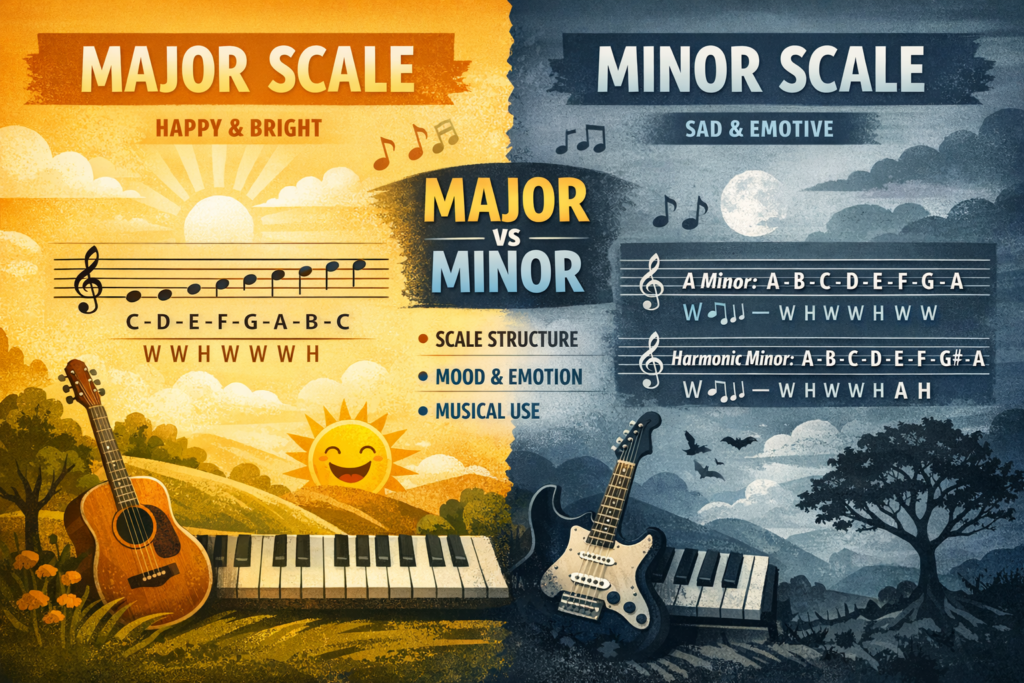
Major and minor scales form the backbone of Western music theory. Almost every melody, chord progression, and harmony in popular, classical, jazz, and film music is derived from these two scale types. Understanding how major and minor scales work is essential for musicians, composers, and producers who want to create music with clarity, emotion, and structure.
What Is a Musical Scale?
A musical scale is an ordered sequence of notes arranged by pitch within an octave. Scales provide a framework for melodies and harmonies, helping musicians understand which notes naturally work together. Among many scale types, major and minor scales are the most widely used and recognized.
The Major Scale
The major scale is known for its bright, happy, and uplifting sound. It is often associated with positive emotions such as joy, confidence, and celebration.
Structure of the Major Scale
The major scale follows a fixed pattern of intervals:
Whole – Whole – Half – Whole – Whole – Whole – Half
For example, the C Major scale:
C – D – E – F – G – A – B – C
This consistent interval pattern allows the major scale to be built starting from any note.
Characteristics of the Major Scale
Bright and open tonal quality
Strong sense of resolution
Commonly used in pop, rock, classical, and folk music
Forms the basis of major chords and diatonic harmony
The Minor Scale
The minor scale has a darker, more emotional, and introspective sound. It is often used to express sadness, tension, mystery, or depth.
Types of Minor Scales
Unlike the major scale, the minor scale has three common forms:
Natural Minor Scale
Interval pattern:
Whole – Half – Whole – Whole – Half – Whole – WholeHarmonic Minor Scale
Similar to natural minor, but with a raised 7th note, creating a stronger resolution.Melodic Minor Scale
Raises the 6th and 7th notes when ascending and returns to the natural minor when descending.
Characteristics of the Minor Scale
Emotional and expressive tonal quality
Creates tension and release
Widely used in classical, film music, rock, and jazz
Forms the basis of minor chords and complex harmonies
Major vs Minor: Key Differences
Mood: Major sounds happy and bright, while minor sounds sad or serious
Interval structure: Different placement of whole and half steps
Emotional impact: Major feels stable; minor feels expressive and dramatic
Usage: Major is common in upbeat songs; minor dominates emotional or intense music
Importance in Songwriting and Composition
Major and minor scales guide:
Melody creation
Chord progressions
Key selection
Emotional storytelling in music
A simple change from a major key to a minor key can completely transform the mood of a song.
Scales in Practical Music
On instruments like guitar, piano, and keyboard, scales help musicians:
Improve finger strength and coordination
Understand fretboard or keyboard layout
Develop improvisation skills
Transition smoothly between chords and melodies
Major and minor scales are the foundation of Western music. The major scale provides brightness and stability, while the minor scale adds emotional depth and complexity. Together, they allow musicians to express a wide range of emotions and ideas.
Mastering these scales is not just a technical exercise but a musical necessity. Whether you are a beginner learning your first scale or an advanced musician refining your compositions, understanding major and minor scales is essential for meaningful and expressive music creation.