
TuneCore vs DistroKid
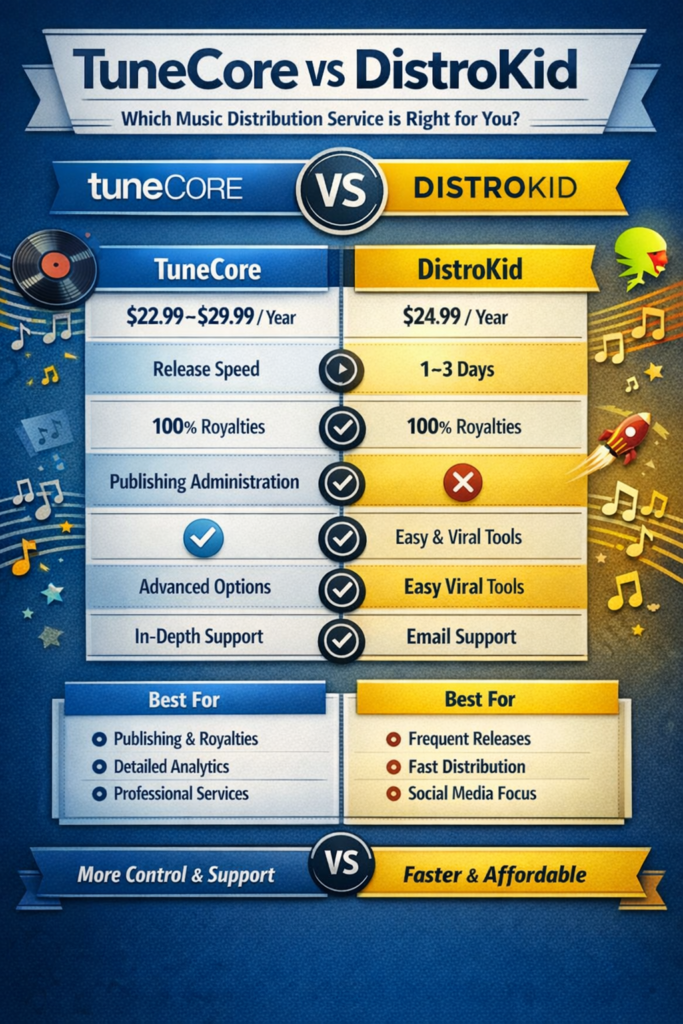
Independent artists seeking digital distribution of their music must choose a service that aligns with their budget, release frequency, and long-term goals. Two of the most widely used distributors are TuneCore and DistroKid. Both help artists distribute music to major streaming platforms such as Spotify, Apple Music, Amazon Music, and others, while allowing artists to retain their royalties. However, the way they operate, price their services, and support artists differs materially.
1. Business Model and Core Philosophy
DistroKid was founded with simplicity and affordability at the center of its offering. Artists pay a flat annual fee for unlimited releases across major digital platforms and keep 100% of their streaming and sales royalties. This model is especially attractive for artists who release frequently and want a “set it and forget it” experience.
TuneCore, historically, was built on a pay-per-release structure that charges for each single or album, though it now also offers subscription plans with unlimited distribution. TuneCore’s broader suite of services often goes beyond distribution into areas like music publishing administration, analytics, licensing tools, and marketing resources—positioning it as more than just a basic distributor.
2. Pricing Structures
DistroKid:
- Annual subscription with unlimited releases for one artist (base tier typically around low-$20 USD per year).
- Optional add-ons (e.g., YouTube Content ID, music video distribution) cost extra.
TuneCore:
- Offers tiered subscription plans (e.g., “Rising Artist,” “Breakout,” “Professional”), with prices varying by level and feature set. Typical starting tiers range from low-$20 to mid-$40+ per year.
- A legacy pay-per-release route still exists for singles and albums if an artist prefers not to subscribe.
Key distinction: DistroKid is typically more cost-efficient for artists releasing music frequently because one subscription covers unlimited releases; TuneCore can be better for those who release less often and want granular control over each project.
3. Royalty Treatment and Payouts
Both platforms allow artists to keep 100% of their royalties from streaming and downloads—the industry standard for independent aggregators. Neither takes a cut of your streaming income, although add-ons or third-party services linked to the platforms can affect total earnings.
However, TuneCore’s publishing administration service is a distinct advantage for artists who want help collecting global mechanical and songwriter royalties—it assists with registrations and collection that typically require separate third-party services if not using TuneCore. DistroKid does not include publishing administration by default, so artists often use external publishers or services like Songtrust.
4. Delivery Speed and Workflow
- DistroKid generally distributes music faster, with uploads often appearing on major streaming platforms within 24–48 hours under optimal conditions.
- TuneCore upload times vary more and commonly take around five to seven days due to manual verification or additional metadata checks.
- For artists planning coordinated campaigns or tight release schedules, DistroKid’s speed can be a decisive factor.
5. Feature Sets Beyond Basic Distribution
| Feature | DistroKid | TuneCore |
|---|---|---|
| Unlimited releases | Yes | Yes |
| Publishing administration | No | Yes |
| Sync licensing tools | Limited/third-party | Yes |
| Analytics & dashboards | Yes | Yes, more detailed |
| YouTube Content ID (add-on) | Paid extra | Included in some plans or add-ons |
| Promotional tools (e.g., pre-save pages) | Yes | Yes |
| Payment splits for collaborators | Yes | Yes, tier dependent |
TuneCore’s breadth—especially publishing and sync licensing opportunities—can benefit artists who want deeper industry support from a single platform. DistroKid’s ancillary tools like pre-save pages, HyperFollow pages for releases, and automatic revenue splits are designed for speed and simplicity.
6. Support, Reputation, and Community Feedback
Reviews and community discussions indicate that DistroKid’s customer support is generally responsive but primarily email-based, while TuneCore offers more structured support, sometimes with tier-based response times. TrustPilot and forum feedback vary widely depending on individual users’ experiences.
DistroKid often scores higher in user satisfaction for straightforward distribution needs, while TuneCore is lauded for support and tools—even if those come at higher cost.
7. When to Choose Which
Choose DistroKid if you:
Plan to release frequently and want predictable, low annual cost.
Want the fastest possible time to digital storefronts.
Prefer a simple workflow with essential promotional tools and unlimited songs for a fixed fee.
Choose TuneCore if you:
Need publishing administration and royalty collection support.
Value in-depth analytics and optional licensing tools.
Prefer structured customer service and industry-level tools that support growth beyond basic distribution.
Both TuneCore and DistroKid remain strong choices for distributing music in 2026. The “best” option depends on your individual strategy:
If cost, speed, and simplicity are most important, DistroKid frequently provides more value for active release schedules.
If long-term revenue management, publishing, and industry tools matter more, TuneCore may better align with professional goals.
Many artists even use both platforms strategically—leveraging one for rapid releases and the other for deeper revenue analytics or publishing services. In any case, examine current pricing and contractual details before committing, as features and fees can evolve with market conditions.
Monetize your traffic instantly—enroll in our affiliate network!
Fala, galera! Tô curtindo a f12betbrasil pra fazer minhas apostas. As odds são boas e tem de tudo que eu preciso. Recomendo! Aposte com f12betbrasil!
Ok83865 seems promising. I will need to investigate and see if it is beneficial. But here’s the link if you want to see: ok83865!
Just stumbled upon 7kbetcom. Looks like they have a decent selection of games. Gonna give it a whirl and see if it’s my lucky day! Give it a look-see: 7kbetcom